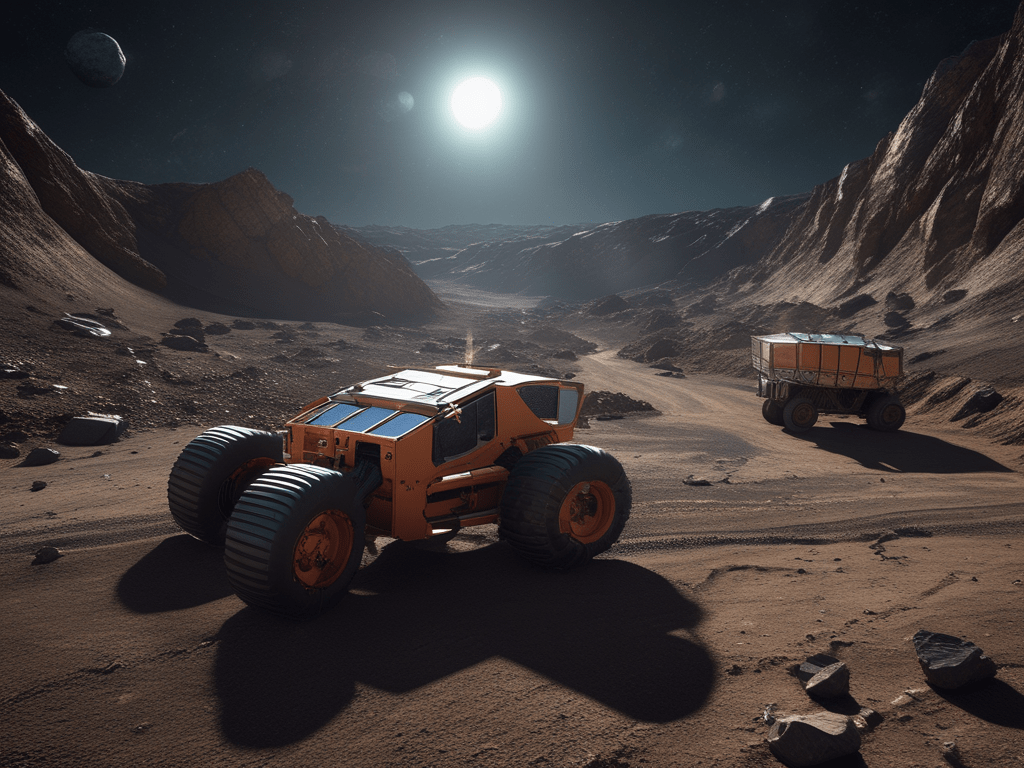
A common consensus across the world is that when we are done trashing this world, we will move to outer space. Although this is a very ill-informed assumption to believe in its entirety, there is some truth to it. While we won’t be able to just pack up and leave Earth, space and more specifically what is in space holds valuable resources that can help us make great leaps in all sorts of fields.
For example, space mining poses the chance of recovering extremely valuable metals from asteroids, moons, and other celestial bodies. These metals can prove extremely useful through economic benefits, like just selling them or using them to build all sorts of products, or technological advancements, like replacing maybe a less sustainable metal in your phone for example. However, it isn’t as cut and dry as shipping up to space, gathering the materials, and sending back down to Earth. As we discussed, it is very hard ethically to assign ownership in space for various reasons. For example, in the very real scenario that many nations in the world in their current state cannot reach space, so how should we allocate space and its resources to them? Or how can we fairly distribute desired parts of space to competing nations? The Outer Space Treaty of 1967 is the guidelines we use for global space law that claims that all of outer space is the “province of humankind” and thus cannot be claimed and following that the Moon Agreement of 1984 are the common heritage of mankind. But, as you can probably tell by the year of its installment, these treaties are lacking language for modern situations and nuances. It is absolutely critical that new treaties and language be put into place to decrease any and all ambiguity when it comes to ownership in space like whether or not private companies should be allowed to claim resources from space and if so how does that affect what nations can attain.
Additionally, this issue may have direct impacts on economic disparities and equity. Outer space is a unique source of revenue, in the way that actually getting there and harvesting materials is one of the most expensive, complex, and dangerous feats that mankind has accomplished. This commodity is one that is very hard to come across, but very fruitful. So the small group that can get these materials are logically the already more wealthy groups. As the old saying goes, the rich get richer. So while these materials can bring opportunities for a lot of wealth, they can also prove harmful to the economy through the marginalization of socio-economic classes.
Lastly, the environmental impact is also one to consider. Going to and from Space is difficult on the environment for various reasons, such as the fuel that releases toxic material into the environment, or the debris that can interrupt ecosystems. Even past that, however, we have to think about how this mining and use of celestial bodies affects the bodies themselves. The celestial bodies that make up outer space are, as you may imagine, absolutely necessary for space. Because really, what is outer space without stars, moons, and planets. Obviously that is not the end-all be-all for space, but they are a majority of space and to mine and diminish them at the rate and level that world nations seem to want would result in a catastrophic change to space of which we have never seen. This begs the question, should we even be space mining or allocating space materials to the nations of the world or even private companies. Environmental preservation is a major focus of today with all sorts of programs, initiatives, and laws being put in place in an attempt to fight ozone degradation, global warming, and climate change. All because we set up a system with resources that was detrimental to our world, and now we want to go to space. I believe that we must consider what we have done to our world, and use it as a guide to our approach to outer space. Now, if that guide says “Do Not Enter” to space, we will only destroy it, then so be it. When it comes to space, this is the absolute highest of stakes, as if we mess it up there is physically nowhere else to go. In this situation, I believe that the consensus would be that this venture is for the future, that the technology we have today is unable to get the results we desire without the consequences we hope to avoid.
It is critical to ask, what is at stake? Three specific issues are readily apparent. International relations, environmental preservation, and equitable distribution of resources. Truthfully, I think the foremost issue of this topic (and the one I have discussed less up to this moment in the essay) is international relations. The majority of space is unknown. In that void, speculation of potential benefits to reap could be the seed to mass conflict on Earth. If we do not establish a moral and ethical code involving conduct and how to properly go about space exploration to adhere to for all nations involved, then the next Space Race will be one of conflict and violence.
In response to this, I proposed a three step plan: the “Regulate, Promote, Invest” or R.P.I. plan. The first step is regulation. In this step I believe that nationals should develop comprehensive regulations to create a modern framework for what we deem as legal and ethical in the pursuit of harnessing the power of space. This phase is meant to either bring new treaties and agreements up to date, such as the aforementioned Outer Space Treaty of 1967 or the Moon Agreement of 1984, or bring about new legislation to fill any voids left by previous laws. Key elements of the new regulations should include and highlight (a) resource allocation, (b) environmental protections, and (c) conflict resolution mechanisms. Discussing resource allocation as early as possible will help establish a system that can ethically ensure that benefits are shared among nations in an agreeable manner so that, for example, developing countries have access to the same advantages as other countries when it comes to space mining. By ensuring environmental protections and implementing standards, we can keep celestial bodies healthy while also profiting. Lastly, implementing conflict resolution mechanisms as quickly as possible is also something that should be a focus as a project that involves as many nations as this can be explosive when different nations and cultures conflict as much as they do. So, implementing conflict resolution mechanisms quickly is extremely important. In the next phase, we should Promote international collaboration. In doing this we can address the issue of economic disparity and ensure that the space resources are equitably shared while also lowering the chance of international conflict. In simple terms, promoting collaboration can only improve technological possibilities, lower individual risk, and bolster international relations. Lastly, the final phase of the R.P.I. the plan is that nations should Invest in sustainable technologies. As I previously discussed, it is very possible that our technology is just not able to get the results we want without the consequences we wish to avoid, so we must invest in the technology that in the future will be able to harvest outer space in a sustainable manner.
In conclusion, space mining holds a promising future for economic and technological advancements but only if we can acknowledge the ethical challenges that come with space mining while addressing them in a collaborative manner. The issues of ownership, environmental impacts, and possible economic disparity are only the forefront of issues: only more will come. So, by developing a clear and legal framework like the R.P.I plan that will be flexible in its implementation, we can address the most obvious issues now while setting ourselves up for opportunities of ample success and advancement.
 Think About It
Leave a comment